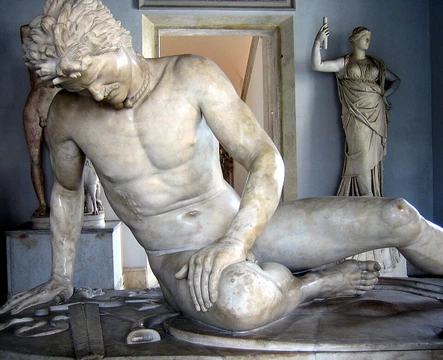
Bust (sculpture)
A sculpted portrait of the head, neck, and upper chest.

Wikipedia / Wikimedia Commons
A bust is a sculpture of the upper human body, showing the head, neck, and part of the chest and shoulders. It usually sits on a plinth. Most busts are portraits meant to capture a specific person’s likeness, though they can also represent a general type. Sculptors use materials like marble, bronze, terracotta, plaster, wax, or wood. Because a bust requires less work, costs less, and takes up much less space than a full-length statue, it has been a common choice for life-size portraiture since ancient times.
A sculpture showing only the head, sometimes with the neck, is more accurately called a “head,” but the terms are often used loosely. Busts may have an integral or separate display stand. The world’s largest bust is the Adiyogi Shiva statue in India, depicting the Hindu god Shiva; it stands 112 feet (34 meters) tall.
**History**
**Antiquity** Sculptural portrait heads from ancient Greece and Rome that stop at the neck are sometimes displayed as busts, but many are fragments from full-body statues or were made to be inserted into a body—a common Roman practice. These are not considered true busts here. Similarly, heads that end at the neck are often mistakenly called busts.
The portrait bust was invented by Hellenistic Greeks, though an Egyptian bust predates Greek examples by five centuries. Few original Greek busts survive, but many Roman copies exist. For instance, four Roman copies of Pericles show him with a Corinthian helmet, but the Greek original was a full-length bronze statue. Busts were very popular in Roman portraiture. This Roman tradition may have started with patrician families keeping wax masks—possibly death masks—of dead relatives in their home atriums. At funerals, these masks were worn by people of similar build in processions, as the historian Polybius noted with surprise during his stay in Rome starting in 167 BC. Later, sculptures replaced or supplemented these masks. Owning such *imagines maiorum* (ancestor portraits) was required for membership in the Equestrian order.
**Middle Ages** Some reliquaries were made as busts, most notably the gold Bust of Charlemagne (c. 1350) still in Aachen Cathedral’s treasury. Otherwise, the bust was a rare format during this period.
**Renaissance** Busts revived in various materials, including painted terracotta, wood, and marble. Early examples were usually flat-bottomed, stopping just belo
- field
- Sculpture
- known_for
- Life-size portrait sculpture of the upper body
- mediums
- Marble, bronze, terracotta, plaster, wax, wood
- largest_example
- Adiyogi Shiva statue, 112 feet (34 m) tall, India
Lore & Background
The portrait bust was a Hellenistic Greek invention, though the Egyptian bust precedes Hellenic productions by five centuries. Very few original Greek examples survive, as opposed to many Roman copies of them. There are four Roman copies as busts of Pericles with the Corinthian helmet, but the Greek original was a full-length bronze statue. They were very popular in Roman portraiture. The Roman tradition may have originated in the tradition of Roman patrician families keeping wax masks, perhaps death masks, of dead members, in the atrium of the family house. When another family member died, these were worn by people chosen for the appropriate build in procession at the funeral, in front of the propped-up body of the deceased. Later these seem to have been replaced or supplemented by sculptures. Possession of such imagines maiorum was a requirement for belonging to the Equestrian order.
During the Middle Ages, some reliquaries were formed as busts, notably the famous Bust of Charlemagne in gold, still in the Aachen Cathedral treasury, from c. 1350. Otherwise it was a rare format. Busts began to be revived in the Renaissance in a variety of materials, including painted terracotta or wood, and marble. Initially most were flat-bottomed, stopping slightly below the shoulders. Francesco Laurana, born in Dalmatia, but who worked in Italy and France, specialized in marble busts, mostly of women. Under the Baroque school the round-bottomed Roman style, including or designed to be placed on a socle, became most common. Gian Lorenzo Bernini did portrait busts of popes, cardinals, and foreign monarchs such as Louis XIV. His Bust of King Charles I of England (1638) is now lost; artist and subject never met, and Bernini worked from the triple portrait painted by Van Dyck. Nearly 30 years later, his Bust of the young Louis XIV was hugely influential on French sculptors. Bernini's rival Alessandro Algardi was another leading sculptor in Rome.
Reader's Guide
The bust format has been a popular style of life-size portrait sculpture since ancient times, valued for its lower cost and smaller space requirement compared to full-length statues. Its origins lie in Hellenistic Greece, though the Egyptian bust predates Greek examples by five centuries. Roman copies of Greek originals survive in greater numbers than the originals themselves. The Roman tradition may have evolved from the use of wax masks of ancestors in family atria and funeral processions, later replaced by sculpted portraits. During the Middle Ages, busts were rare except for reliquaries like the gold Bust of Charlemagne. The Renaissance revived the format in painted terracotta, wood, and marble, often flat-bottomed. The Baroque period saw the round-bottomed Roman style become dominant, with Gian Lorenzo Bernini creating influential portrait busts of popes, cardinals, and monarchs, including a lost bust of King Charles I and a bust of the young Louis XIV that influenced French sculptors. The world's largest bust is the Adiyogi Shiva statue in India, 112 feet tall.
Did You Know?
- The portrait bust was a Hellenistic Greek invention, though the Egyptian bust precedes Hellenic productions by five centuries.
- The Roman tradition may have originated from patrician families keeping wax masks, perhaps death masks, of dead members in the atrium.
- The Bust of Charlemagne in gold, from c. 1350, is a reliquary still in the Aachen Cathedral treasury.
- The world's largest bust sculpture is the Adiyogi Shiva statue in India, 112 feet (34 m) tall.
Frequently Asked Questions
What exactly is a bust in sculpture?
A bust is a sculpted portrait depicting a person's head, neck, and upper chest and shoulders, usually displayed on a pedestal. It is designed to capture the likeness of a particular individual or to represent a generalized type rather than a full body.
What materials can a bust be made from?
Sculptors work in a range of mediums for busts, including marble, bronze, terracotta, plaster, wax, and wood. The choice of material often depends on the desired surface finish, durability, and the artist's preferred technique.
Why did busts become such a popular form of portraiture?
Because they demand far less time, expense, and physical space than a full-length statue, busts became a practical go-to option for life-size portraits. This efficiency made them a staple of portraiture from ancient times onward.
How is a bust different from a head-only sculpture or a full statue?
A bust specifically includes the head, neck, and a portion of the chest and shoulders, sitting somewhere between a head-only piece and a complete figure. A sculpture showing just the head (and sometimes the neck) is a more limited form, while a full statue renders the entire body.
What is the largest bust sculpture in the world?
The Adiyogi Shiva statue in India, standing 112 feet (34 meters) tall, holds the record as the largest example of this sculptural form.
More in Sculpture 1-24
Spotted an error? Know more?
This is a living reference — every entry is fact-audited, and reader corrections feed straight into our audit queue. Suggest an edit · See this site's audit record