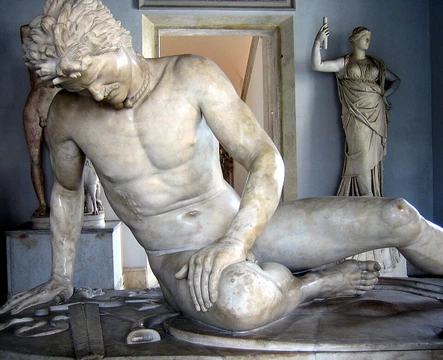
Baroque sculpture
Baroque sculpture emphasized dynamic movement and multiple viewing angles.

Wikipedia / Wikimedia Commons
Baroque sculpture belongs to the Baroque style, active from the early 17th to the mid-18th centuries. It came after Renaissance and Mannerist sculpture, and was followed by Rococo and Neoclassical sculpture. The style first took shape in Rome, then spread across Europe and into European colonies, notably Latin America and the Philippines.
Groups of figures became more important in Baroque sculpture. Human forms showed dynamic movement and energy, often spiraling around an empty central vortex or reaching outward into the surrounding space. These works typically had multiple ideal viewing angles. They continued the Renaissance shift away from relief toward sculpture in the round, designed to sit in the middle of a large space. Elaborate fountains—like Gian Lorenzo Bernini’s Fontana dei Quattro Fiumi in Rome (1651) or those in the Gardens of Versailles—were a Baroque specialty. The style suited sculpture perfectly, with Bernini as the dominant figure, seen in works such as *Ecstasy of Saint Theresa* (1647–1652). Many Baroque sculptures added extra-sculptural elements, such as concealed lighting or water features, or fused sculpture with architecture to create a transformative experience. Artists saw themselves in the classical tradition but admired Hellenistic and later Roman sculpture, rather than the more “Classical” periods as understood today.
The Protestant Reformation largely stopped religious sculpture in much of Northern Europe. Secular sculpture—especially portrait busts and tomb monuments—continued, but the Dutch Golden Age had no significant sculptural component outside goldsmithing. In direct reaction, sculpture remained as prominent in Catholicism as in the late Middle Ages. The Catholic Southern Netherlands saw a flourishing of Baroque sculpture from the second half of the 17th century, with local workshops producing church furniture, funeral monuments, and small-scale works in ivory and durable woods like boxwood. Flemish sculptors helped spread the Baroque idiom abroad, including to the Dutch Republic, Italy, England, Sweden, and France.
In the 18th century, much sculpture continued on Baroque lines—the Trevi Fountain was completed only in 1762. The Rococo style was better suited to smaller works.
The Baroque style emerged from Renaissance sculpture, which had idealized the human form based on classical Greek and Roman models. Mannerism mod
- field
- Sculpture
- period
- Early 17th to mid 18th centuries
- earliest_centre
- Rome
- key_figure
- Gian Lorenzo Bernini
- influences
- Hellenistic and later Roman sculpture, Mannerism
- successors
- Rococo and Neoclassical sculpture
Lore & Background
Other notable Italian Baroque sculptors included Stefano Maderno, Francesco Mochi, Alessandro Algardi, and the Flemish sculptor François Duquesnoy. In France, Baroque sculpture was intended to glorify the French monarchs, produced by sculptors of the Royal Academy of Painting and Sculpture, and closely supervised by Jean-Baptiste Colbert. French sculptors worked with architects and landscape designers to create the sculptural effects at the Palace of Versailles and its gardens.
Reader's Guide
Baroque sculpture marked a significant shift from relief to sculpture in the round, designed to be placed in the middle of large spaces. Groups of figures assumed new importance, spiraling around an empty central vortex or reaching outward. The style added extra-sculptural elements such as concealed lighting or water fountains, fusing sculpture and architecture to create a transformative experience. The Protestant Reformation had stopped religious sculpture in much of Northern Europe, but in Catholic regions sculpture flourished, with Flemish sculptors playing a prominent role in spreading the Baroque idiom abroad. The Rococo style later succeeded Baroque, better suited to smaller works.
Did You Know?
- Baroque sculpture often had multiple ideal viewing angles, a feature that became central to the style in works like Bernini's *Ecstasy of Saint Theresa*.
- The Trevi Fountain, completed in 1762, represents the final act of the Italian Baroque.
Frequently Asked Questions
Who is Baroque sculpture?
Baroque sculpture is an art movement spanning roughly 1600 to 1750, emerging from the traditions of Renaissance and Mannerist work. It first crystallized in Rome before spreading across Europe and into colonial regions such as Latin America and the Philippines.
What are Baroque sculpture's defining traits?
The movement is known for dramatic, spiraling compositions that invite the viewer to walk around the piece and see it from several ideal angles. Figures often twist around a central void or thrust outward, creating a sense of kinetic energy rather than static repose.
Who is the key figure of Baroque sculpture?
Gian Lorenzo Bernini stands as the defining sculptor of the era, shaping the movement's signature dynamism and theatrical spatial engagement. His Roman workshop set the template that other European studios would later adopt and adapt.
What influences shaped Baroque sculpture?
The style drew heavily on the dramatic gestures found in Hellenistic and later Roman works while also reacting against the more restrained Mannerist approach. This blend of classical intensity and deliberate theatricality gave the movement its distinctive visual language.
What came after Baroque sculpture?
Baroque sculpture gave way to the lighter, more ornamental Rococo style, which was in turn succeeded by the stricter Neoclassical movement. Together these successors marked a gradual shift away from the intense dynamism that had defined the Baroque period.
More in Sculpture 1-24
Spotted an error? Know more?
This is a living reference — every entry is fact-audited, and reader corrections feed straight into our audit queue. Suggest an edit · See this site's audit record